



Internationalisation and Innovation in Physiotherapy Education through Erasmus+
This week, CEERRF students benefited from innovative teaching sessions in return-to-sport rehabilitation as part of an Erasmus+ STA mobility programme (Staff Mobility for Teaching).
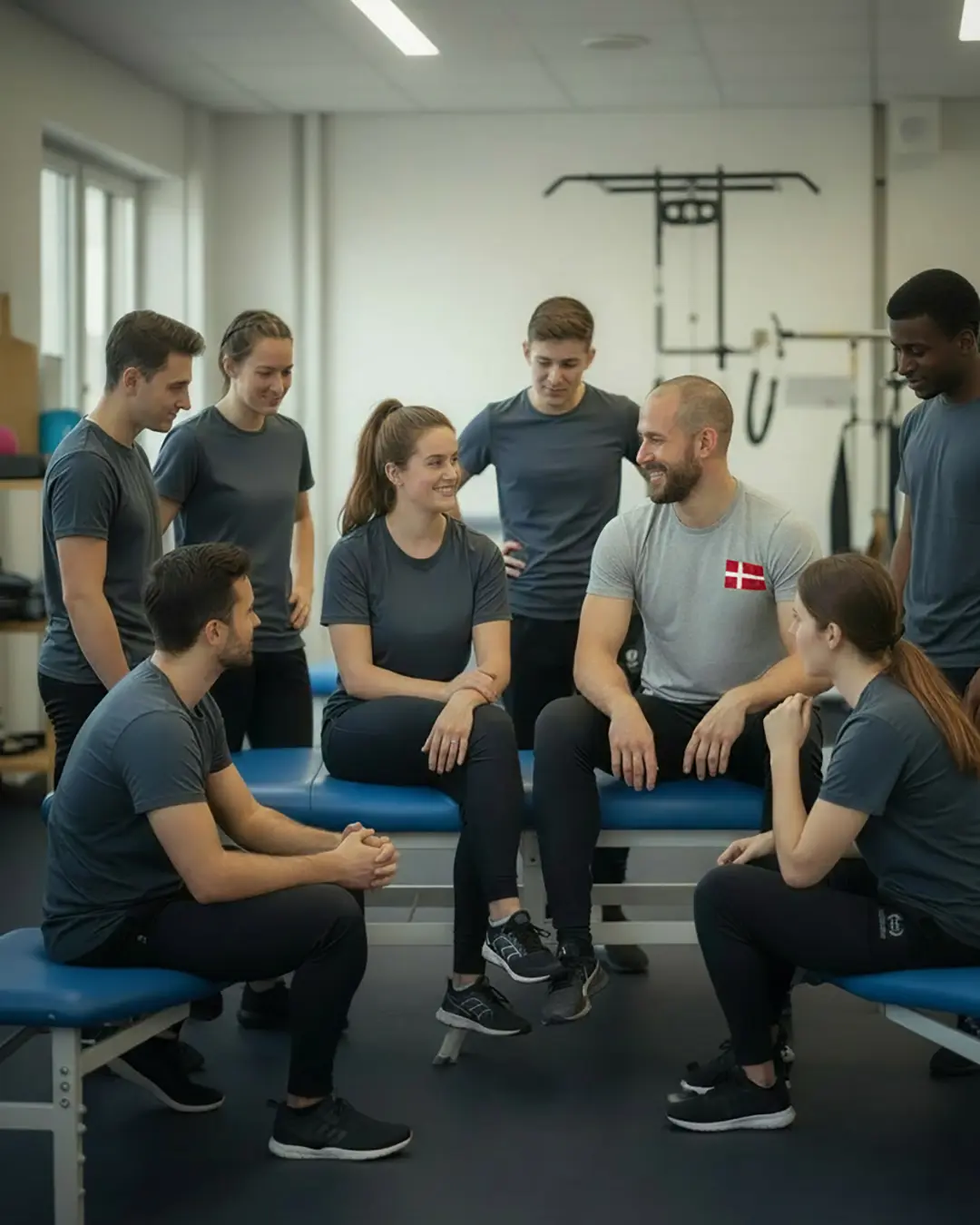
We were delighted to welcome two lecturers from the University College South Denmark in Esbjerg, Katrine Oertel and Thomas Svighyunding, who shared their expertise with our first- and second-cycle physiotherapy students through practical clinical case studies (ACL reconstruction, total knee replacement, return-to-sport rehabilitation, etc.).
This French-Danish collaboration perfectly reflects the core values of the Erasmus+ programme:
- sharing pedagogical expertise,
- strengthening international cooperation,
- fostering innovation in higher education,
- and developing the professional skills of future physiotherapists.
The sessions also integrated generative artificial intelligence as a pedagogical tool to support clinical reasoning. Students were encouraged to analyse and solve complex clinical scenarios using AI-assisted approaches, promoting critical thinking and evidence-based decision-making.
Practical workshops were carried out using connected strength-training technologies provided by our partner EGYM. These tools enabled students to explore personalised rehabilitation and strengthening protocols based on measurable performance data. The integration of digital technologies into teaching helps bridge the gap between academic learning and modern clinical practice.

A warm thank you to our Danish colleagues for the quality of their teaching and commitment to our students, as well as to Julien Cramet and Clément de Renty for their collaborative work alongside them.
At CEERRF, we strongly believe that Erasmus+ mobility programmes are a key driver for pedagogical innovation, intercultural exchange, and the development of a truly European learning environment for future healthcare professionals.